


Imagine landing in Barcelona, ready to snap photos and update loved ones. You reach for your phone charger, only to find the plug doesn’t fit the wall socket. Your camera battery is red, tablet at 10%. Panic sets in. This common scenario costs UK travellers time, money, and a lot of frustration.
Picking the right travel adapter prevents this. It’s not just about fitting a plug; it’s about safeguarding your devices and ensuring consistent power abroad. With countless options, understanding the nuances of voltage, wattage, and universal compatibility is key for any journey in 2026. This guide cuts through the noise. We break down what you need, what to avoid, and recommend specific adapters that deliver.
Why Your UK Plugs Won’t Work (And What To Do)
Your trusty three-pin UK plug (Type G) is a standard for good reason: it includes a fuse and offers a secure connection. However, outside the UK and a few other former British territories, it’s largely useless. Most of the world uses different plug shapes. Attempting to force a UK plug into a foreign socket is dangerous. It risks damaging both your device and the electrical outlet. More importantly, it creates a fire hazard.
Beyond the physical plug shape, voltage differences are critical. The UK operates on a nominal voltage of 230V. Many countries, particularly in North America and parts of Japan, use 120V. Others, like much of Europe, are similar to the UK at 220-240V. Plugging a 120V-only device into a 230V supply can instantly destroy it. A travel adapter changes the plug shape, not the voltage. For voltage conversion, you need a separate voltage converter, though most modern electronics are dual voltage.
Understanding International Socket Types
There are 15 main types of electrical sockets and plugs in the world, designated by letters A through O. The UK uses Type G, a rectangular three-pin plug. Europe predominantly uses Type C (two round pins) and Type F (two round pins with two earth clips). North America uses Type A (two flat parallel pins) and Type B (two flat parallel pins with a round earth pin). Australia and New Zealand use Type I (two flat pins in a V-shape with an earth pin). Each type is physically incompatible with others.
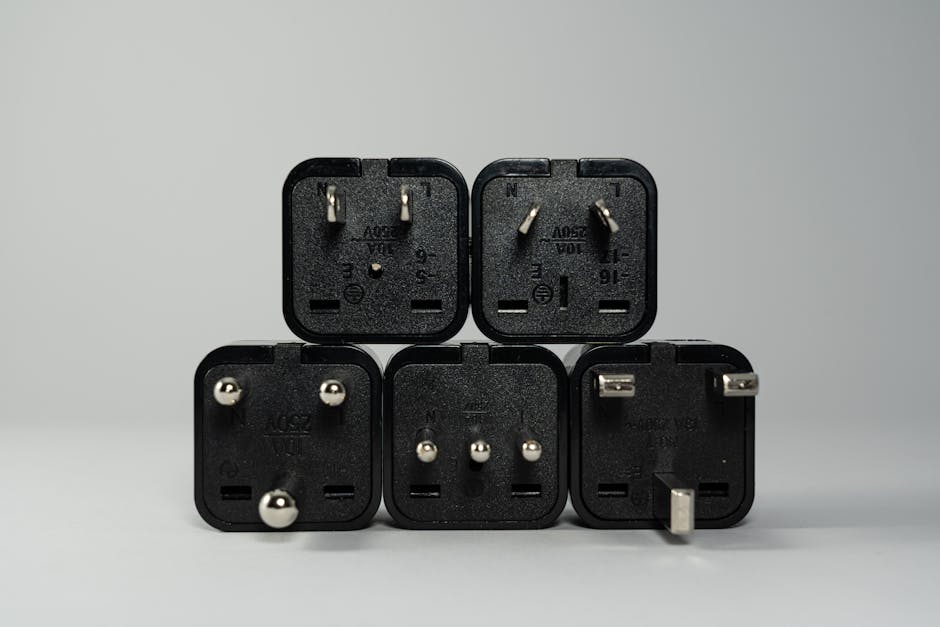
A good travel adapter provides the necessary physical connection. It allows your UK device’s plug to interface safely with the local wall socket. Universal adapters offer sliding pins for various configurations, covering the most common types. Single-country adapters are fixed for one region.
The Voltage Mismatch Dilemma
Modern devices, especially chargers for phones, tablets, and laptops, are typically “dual voltage.” This means they can operate safely on a range from 100V to 240V. Check your device’s power brick for labels like “INPUT: 100-240V, 50/60Hz.” If your device is dual voltage, you only need a travel adapter for the plug shape. You do not need a voltage converter.
However, older appliances, hair dryers, curling irons, or some medical devices might be single voltage. Using a 120V hair dryer in a 230V country with just a plug adapter will likely burn it out or cause a short circuit. For these items, a voltage converter is essential. It’s typically larger and heavier than a simple adapter and often overkill for most travellers in 2026, given device advancements.
What Happens If You Force It?
Never try to force a plug into an incompatible socket. The pins on a UK plug are too thick for many foreign sockets, and the spacing is wrong for most others. Forcing it can bend or break the socket, damage the plug, or worse, expose live wires. This risks electrical shock or fire. Electrical systems are designed with safety in mind, and bypassing these design features by using brute force is incredibly reckless. Always use the correct adapter for your destination.
Universal vs. Single-Country Adapters: Which Is Right?

Choosing between a universal and a single-country adapter depends on your travel habits and priorities. Both have distinct advantages and drawbacks. Many travellers default to universal options for their versatility, but a single-country adapter can sometimes be the more practical choice for specific trips.
Key Differences Explained
A universal travel adapter is an all-in-one unit. It features multiple retractable pins that slide out to match various international socket types (e.g., EU, US, AU, UK). Often, these also integrate USB charging ports for phones and tablets. Their main appeal is convenience: one adapter for almost any destination.
A single-country travel adapter, by contrast, is designed for one specific region. For example, a UK to EU adapter will only allow a UK plug to fit into European (Type C/F) sockets. They are usually smaller, lighter, and often more robust for their specific purpose. They rarely include additional USB ports.
Here’s a quick comparison:
| Feature | Universal Travel Adapter | Single-Country Adapter |
|---|---|---|
| Compatibility | 150+ countries (all major types) | One specific region/country |
| Size & Weight | Bulkier, heavier | Compact, lightweight |
| USB Ports | Often includes multiple USB-A/C | Rarely includes any |
| Cost | Typically £25-£40+ | Often £5-£15 |
| Durability | Moving parts can wear | Fixed, generally very durable |
| Best For | Frequent, multi-country travellers | Specific, repeated trips to one region |
When to Pick a Universal Adapter
Opt for a universal adapter if you are a frequent international traveller visiting multiple countries with differing plug types. If your itinerary includes a stop in the US, then Europe, and then Southeast Asia, a universal adapter is indispensable. It eliminates the need to carry multiple single adapters, streamlining your packing. Look for models with integrated USB-C Power Delivery (PD) ports. These are crucial for fast-charging modern laptops, tablets, and phones, which often draw more power than traditional USB-A ports can provide. They are also excellent if you travel with many USB-chargeable devices, reducing the number of separate wall chargers you need.
Why a Single-Country Might Be Better
A single-country adapter shines for specific, repeated travel. If you regularly visit family in Spain, for instance, a dedicated UK to EU adapter is more compact and less prone to mechanical issues than a universal one. They are often cheaper, making them ideal if you need several for different family members or if you tend to misplace them. Single-country adapters are also generally more robust due to their lack of moving parts. They take up minimal space in your bag, leaving more room for souvenirs. However, remember you’ll need one for each different plug type you encounter on a multi-destination trip.
The Biggest Travel Adapter Mistakes UK Travellers Make
Many travellers underestimate the complexity of travel adapters, leading to common errors. These mistakes range from minor inconveniences to serious safety hazards or damaged electronics. Avoiding them requires a little foresight and understanding of electrical basics.
-
Overlooking Power Delivery (PD) Capabilities
A common oversight in 2026 is assuming all USB ports are equal. Older universal adapters often only have standard USB-A ports, delivering 5V at 1A or 2.4A (5W to 12W). This is fine for older phones or small devices, but modern smartphones, tablets, and especially laptops require significantly more power for efficient charging. Without USB-C Power Delivery (PD) ports, charging a MacBook Air might take half a day, or not charge at all while in use. For instance, a typical laptop requires 30W to 65W, which only a dedicated USB-C PD port can supply. Always check for a USB-C PD output, ideally 30W or higher, if you travel with power-hungry electronics.
-
Ignoring Safety Certifications
Cheap, unbranded adapters flooding online marketplaces often lack crucial safety certifications. Look for clear markings like CE (Conformité Européenne), RoHS (Restriction of Hazardous Substances), and ideally, local country-specific approvals like UL (Underwriters Laboratories for North America) or BSI (British Standards Institution). These certifications indicate that the product meets stringent safety standards for electrical safety, material composition, and environmental impact. An adapter without these can be poorly constructed, prone to overheating, short-circuiting, or even fire. The cost saving on a non-certified adapter is not worth the risk to your devices or your safety.
-
Buying Cheap, Unbranded Units
This ties into safety certifications but extends to overall quality and reliability. Extremely cheap adapters often use substandard internal components, leading to poor performance and short lifespans. Connections can be loose, leading to intermittent charging or sparks. The plastic housing might be flimsy and crack easily. Paying a little extra for a reputable brand ensures better internal wiring, sturdy construction, and reliable operation. Brands like Skross, Epicka, and Tessan have established reputations for quality within the travel adapter market.
-
Confusing Adapters with Converters
As discussed, an adapter changes the physical plug shape. A converter changes the voltage (e.g., 230V to 120V). Most travellers in 2026 do not need a voltage converter because their devices are dual voltage. However, if you are bringing a single-voltage appliance like a specific hair dryer or medical device, an adapter alone will not suffice. Plugging a 120V device into a 230V outlet with just an adapter will likely destroy the device or trip the circuit breaker. Always verify your appliance’s input voltage requirements. If it’s single voltage and incompatible with the local grid, you need a step-down voltage converter, which is a much larger and more expensive item.
-
Not Having Enough Ports
You arrive at your hotel, plug in your universal adapter, and realise it only has one USB port. You have your phone, tablet, smartwatch, and portable power bank all needing a charge. This quickly becomes a bottleneck. Consider your typical charging needs. If you travel with multiple USB-powered devices, choose an adapter with several USB-A ports and at least one high-power USB-C PD port. Some adapters offer 4-5 USB ports plus the main AC outlet, allowing you to charge everything simultaneously from a single wall socket.
Top Travel Adapter Picks for UK Travellers 2026

Choosing a travel adapter means balancing features, budget, and reliability. Based on common UK travel needs in 2026, here are our top recommendations, each designed to meet specific traveller profiles.
Best All-Rounder: Skross World Adapter MUV USB
The Skross World Adapter MUV USB is our top pick for most UK travellers. Skross is a Swiss brand known for its robust engineering and compact designs. This adapter is incredibly reliable, covering plug types for over 220 destinations worldwide (including Europe, USA, Australia, and China). It’s smaller than many universal adapters, making it easy to pack. It features two integrated USB-A ports, delivering a combined 2.4A, which is sufficient for charging two smartphones simultaneously at a decent speed. It includes essential safety features like child-safe shutters and an integrated fuse. The build quality feels premium and durable. Expect to pay around £30 for this model. It’s not designed for high-power laptops, but for phones, tablets, and smaller USB devices, it excels in portability and reliability.
Best for Power Users: Epicka Universal Travel Adapter
For those travelling with laptops, multiple devices, or needing faster charging, the Epicka Universal Travel Adapter is the superior choice. This adapter usually features a more robust power output than typical models. Crucially, it includes a high-power USB-C Power Delivery (PD) port, often capable of 45W, alongside three to four standard USB-A ports. This 45W USB-C PD port can fast-charge most modern laptops, larger tablets, and quick-charge compatible smartphones rapidly. It covers over 150 countries, features surge protection, and has an integrated fuse system. While slightly larger than the Skross MUV, its charging capabilities justify the extra bulk for tech-heavy travellers. Price typically sits around £35-£40. If you value speed and versatility for all your devices, the Epicka stands out.
Best Budget Option: Tessan Universal Travel Adapter
If you’re looking for excellent value without compromising too much on essential features, the Tessan Universal Travel Adapter is a solid contender. Tessan offers a range of universal adapters that typically cover 150+ countries and include multiple USB-A ports, often four, providing a total output of around 3.4A. While these models usually lack a high-wattage USB-C PD port, they are perfectly capable of charging multiple phones, tablets, and smaller devices simultaneously. They usually incorporate a fuse and safety shutters. These adapters are very competitively priced, often found for £20-£25. It’s ideal for travellers whose main concern is charging several mobile devices and don’t need to power a laptop or high-demand devices via USB-C. This adapter delivers reliable basic functionality at an accessible price point.
One Critical Safety Feature You Can’t Ignore
The single most overlooked feature in any travel adapter is its internal fuse. This tiny component protects your expensive electronics, and often the adapter itself, from power surges. Without it, a sudden spike in voltage could fry your phone or laptop. Always confirm a built-in, replaceable fuse.
Choosing the right travel adapter is a small decision that makes a huge difference to your travel experience. Don’t let a dead battery or damaged device spoil your trip. Invest in a quality adapter that matches your needs, ensuring you stay connected and powered wherever your adventures take you.