

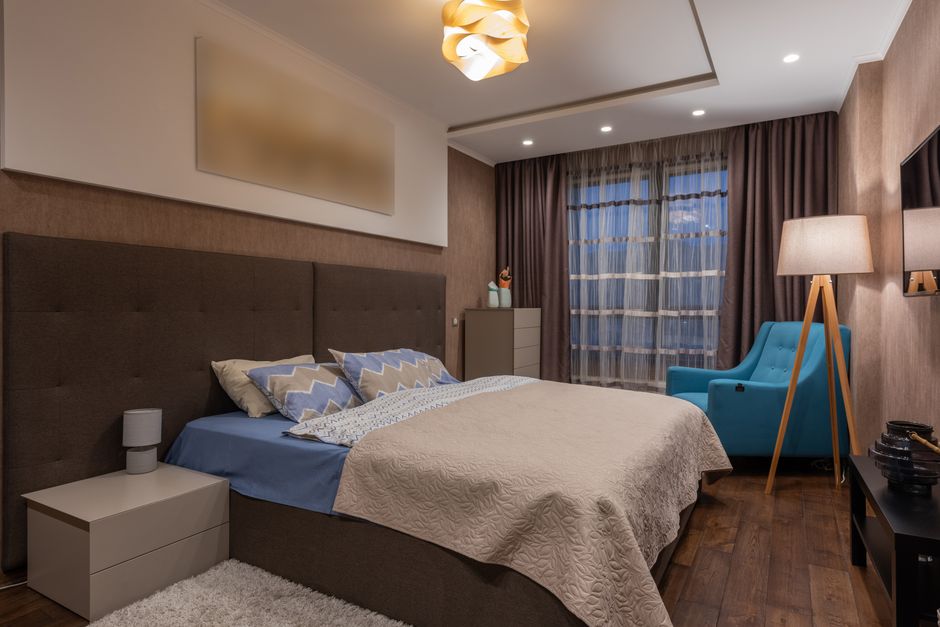
Why warm light works on dark winter mornings
Verdict: Start with layered warm light, not one bright ceiling fixture. A dark winter morning feels harsh when the room jumps from black to a single exposed bulb. The better fix is a low-glare light near the bed, a wider pool of light in the room, and brighter task light where you dress, make coffee, or read.
Warm does not mean dim
Color temperature and brightness solve different problems. Color temperature is measured in Kelvin. A 2200K to 2700K bulb looks amber or warm, while a 3000K to 4000K bulb looks cleaner and more neutral. Lumens measure the amount of light. A warm 800-lumen bulb can still light a small bedroom well; a warm 250-lumen bulb may only work as an accent. For winter mornings, use 2700K near the bed and around 3000K in a dressing or kitchen area. That keeps the first light gentle without leaving you searching for socks in the dark.
Use light from more than one height
One ceiling lamp creates strong shadows beneath shelves, cabinets, and your own face. Put one lamp at eye level or slightly below, then add a second source at waist or floor height. Light bouncing off a pale wall feels softer than light aimed directly at your eyes. Frosted shades also spread the beam and hide bright LED points. The goal is not maximum brightness. It is an even transition from sleep to movement, with enough visibility to prevent trips, glare, and the urge to retreat under the duvet.
How to choose brightness, color temperature, and placement
Verdict: Buy for the task and room size, then tune the warmth. A bulb label alone does not tell you how comfortable the room will feel.
Use this five-step buying check
- Measure the room and count the existing fixtures before buying bulbs. A small bedroom often needs 800 to 1,500 total lumens from several sources, while a larger open room may need 2,000 to 4,000.
- Choose 2200K to 2700K for bedside lamps and 2700K to 3000K for general morning lighting. Reserve 3500K or higher for detailed work when you need sharper contrast.
- Check the base and shape. E26 is common in the United States, while E12 appears in many decorative lamps. An A19 bulb may not fit a narrow shade or a fully enclosed fixture.
- Check dimmer compatibility. A bulb marked non-dimmable can flicker, buzz, or fail when connected to a wall dimmer.
- Look for a frosted diffuser and a color-rendering index of at least 80. A CRI of 90 or higher is preferable near wardrobes, mirrors, and makeup areas.
Place the first light where your hand can reach it
The first morning light should not require a phone, a walk across the room, or a bright overhead switch. Put a lamp within arm’s reach and aim it toward a wall or shade. For a bedside lamp, the bottom of the shade should sit roughly level with your shoulder when you are seated. For a floor lamp, place it beside a chair or along a wall rather than directly behind a screen. This reduces glare while still opening a clear path through the room.
Are smart bulbs worth buying for winter mornings?
Verdict: Smart bulbs are worth the money for people who struggle to get out of bed in darkness. They are unnecessary for a lamp that already sits beside your hand and has a reliable dimmer.
Can a smart bulb replace a sunrise alarm?
It can cover the basic job, but it will not imitate sunlight perfectly. A smart bulb can begin at a low amber setting 20 to 30 minutes before your alarm, then rise toward a brighter neutral white. That gradual change gives your eyes time to adjust and removes the shock of switching on a ceiling light. The LIFX Color A19 reaches 1,100 lumens, works over Wi-Fi without a separate hub, and covers a stated 1,500K to 9,000K range. It is the clearest pick when you want one bulb to handle both warm wake-up light and brighter morning task light.
When does a smart bulb create more trouble?
Smart control adds failure points: a disconnected Wi-Fi network, an app account, a dead phone, or a wall switch left in the off position. If you need a light that works during a power or network problem, use a normal dimmable bulb for the main safety light and reserve the smart bulb for an accent lamp. IKEA TRÅDFRI is the better middle ground when you want wireless dimming at a lower entry cost, though the remote or hub can add to the final bill.
The mistakes that make warm lighting feel gloomy
Verdict: The most common error is confusing warm light with weak light. A room can look cozy and still provide enough brightness for safe movement, dressing, and breakfast.
Mistake one: using only one central fixture
A single ceiling lamp throws light downward, leaves corners dark, and creates hard shadows across the floor. Add a lamp near the bed and another near the main morning task. If the room remains flat, bounce light toward a wall instead of buying a more intense bulb. This usually improves comfort for less money than replacing the fixture.
Mistake two: ignoring the shade and the switch
A dark shade can absorb much of the useful output, while a clear shade can expose harsh LED points. Choose a pale fabric or opal diffuser for the first light of the day. Exclusion warning: never install a bulb in a fixture unless the bulb’s shape, wattage, base, and enclosed-fixture rating match the fixture instructions. Do not place a non-dimmable bulb on a dimmer, and do not cover a lamp with clothing, paper, or a blanket while it is operating. These small compatibility errors cause flicker, heat, buzzing, or early failure.
My product picks for different morning problems

My opinion: Most homes should start with inexpensive 2700K LEDs, while people who repeatedly snooze through dark mornings should buy one smart 1,100-lumen bulb before upgrading every fixture.
Best low-cost fix: IKEA SOLHETTA
Choose the IKEA SOLHETTA E26 when the problem is simply an unpleasant or missing bedside bulb. It is not a sunrise system, but it is the strongest value for a table lamp, reading lamp, or small bedroom fixture. Buy two, place one on each side of the bed if the room is shared, and use a plug-in timer only if you need automatic control.
Best smart wake-up bulb: LIFX Color A19
Choose the LIFX Color A19 when you want a gradual wake-up sequence without buying a bridge. Its 1,100-lumen output is bright enough to serve as a main lamp, while its 1,500K to 9,000K range gives you warm amber light at wake-up and cleaner white light once you are moving. The concrete choice is simple: SOLHETTA for a manual room, LIFX for scheduled light, and Hue only when advanced scenes or an existing Hue system justify the premium.
A practical seven-day lighting setup plan
Verdict: Improve one morning zone first, measure the result, then expand. Buying ten bulbs before testing one lamp is how people waste money on lighting that still feels wrong.
Use this sequence
- Day one: write down the room’s fixture types, bulb bases, and current wattage.
- Day two: place a temporary lamp near the bed or doorway and aim it at a wall.
- Day three: test 2700K for the first light and 3000K near the wardrobe or kitchen.
- Day four: check glare while seated, standing, and looking toward a mirror.
- Day five: add a second light at a different height instead of increasing the first bulb’s output.
- Day six: test the setup at the actual winter wake-up time, before sunrise.
- Day seven: keep the arrangement only if you can walk, dress, and prepare breakfast without switching on a harsh overhead light.
Budget and safety check
Local electrical rules and rental restrictions vary by state and municipality, especially when you replace hardwired fixtures or add new wiring. For a plug-in lamp, the main checks are simple: use the correct base, stay within the fixture’s wattage limit, keep ventilation clear, and use a qualified electrician for permanent changes. The single most important takeaway is this: use layered 2700K light at different heights, then add smart scheduling only when darkness—not bulb brightness—is what keeps you in bed.